Night Vision vs. Thermal Imaging: What’s the Difference?
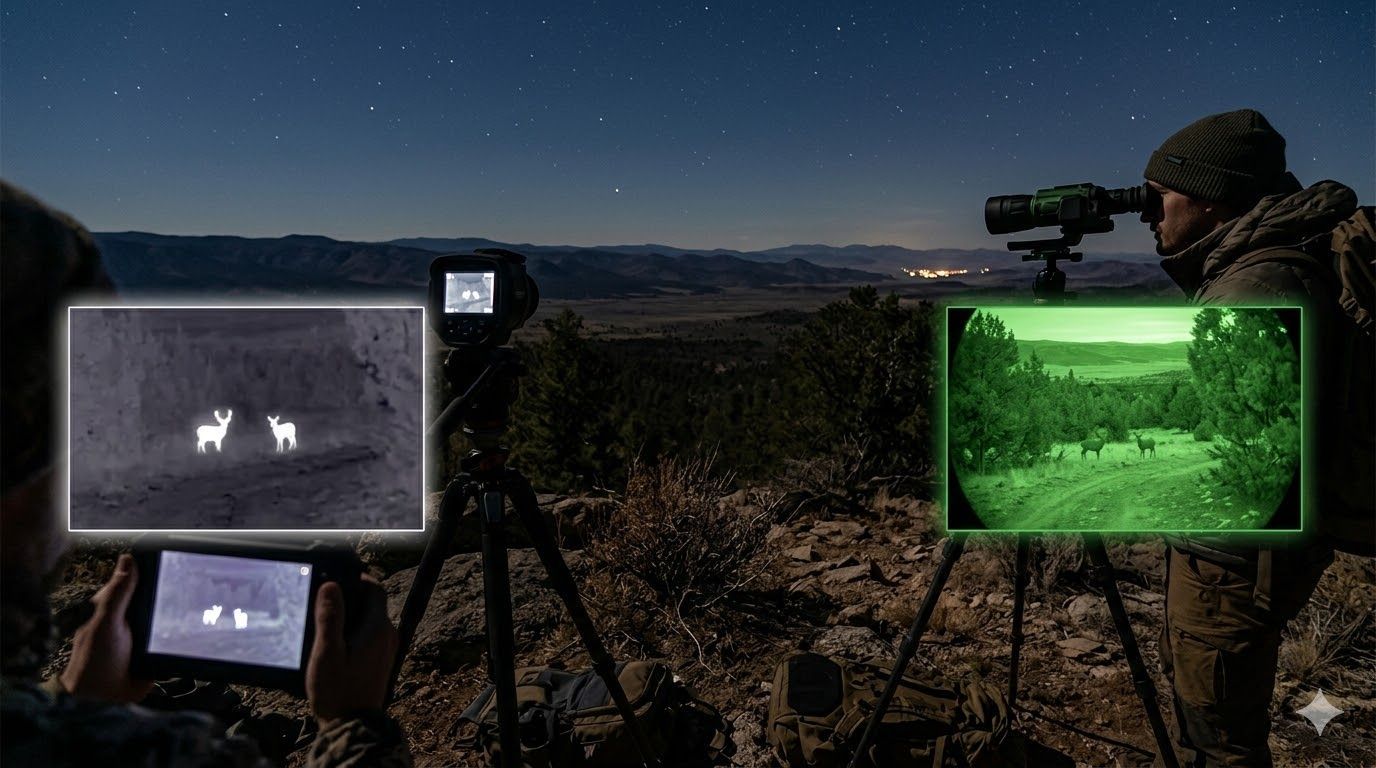
Night Vision vs. Thermal Imaging: What’s the Difference?
We get a lot of questions at TheQuarterMaster about the difference between night vision and thermal imaging, and understanding this distinction is crucial for your loadout.
While both technologies are explicitly designed to help you see in low-light or zero-light conditions, they rely on very different technologies and serve entirely different operational purposes. Here is everything you need to know to choose the right optic for your needs.
Thermal Imaging: The Ultimate Detection Tool
Thermal devices do not rely on light; instead, they detect heat signatures.
When looking through a thermal scope, you might easily spot a heat source in the pitch-black distance. However, what you see is often a glowing shape or "blob" rather than a detailed image. Thermal technology tells you that something is there, but it won't always tell you exactly what it is.
That glowing heat source could be:
- A person
- An animal
- A recently used vehicle or warm engine block
- Another warm object retaining heat in the environment
The Bottom Line: Because it cuts through darkness, fog, and light foliage to highlight heat, thermal is best used for detection.
Night Vision: Your Go-To for Target Identification
Night vision works on a completely different scientific principle. It gathers ambient light from natural sources—such as the moon and stars—and amplifies it to brighten your field of view and reveal visible detail.
Because night vision processes actual light rather than heat, it allows you to clearly make out the shape, form, and specific features of the object you are viewing.
The Bottom Line: Because it provides environmental detail and visual clarity, night vision is best used for identification.
The Golden Rule to Remember:
- Thermal helps you detect.
- Night vision helps you identify.
What Factors Affect the Cost of These Optics?
Whether you are looking at thermal or night vision, pricing scales with capability. As a general rule, you can expect to pay more for:
- Higher Magnification: Seeing further distances clearly requires better glass and technology.
- Advanced Technology: Newer generation tubes or higher-resolution thermal sensors drive up the price.
Higher-end units consistently offer superior image quality, ruggedness, extra features, and reliable performance in the field.
ATN Night Vision Options at The Quartermaster
If you are ready to upgrade your rifle setup, we stock high-quality ATN night vision scopes at The Quartermaster. Currently, we offer these scopes in two versatile configurations:
Key Features of our ATN Scopes:
- Universal Mounting: They easily mount onto any standard Picatinny rail, making them highly adaptable for a wide range of rifle platforms.
- Hybrid Lighting: While they operate beautifully using ambient light, they also include a built-in infrared (IR) illuminator. This allows you to project your own invisible light source, guaranteeing improved visibility in ultra-dark conditions where natural moonlight or starlight is limited.